
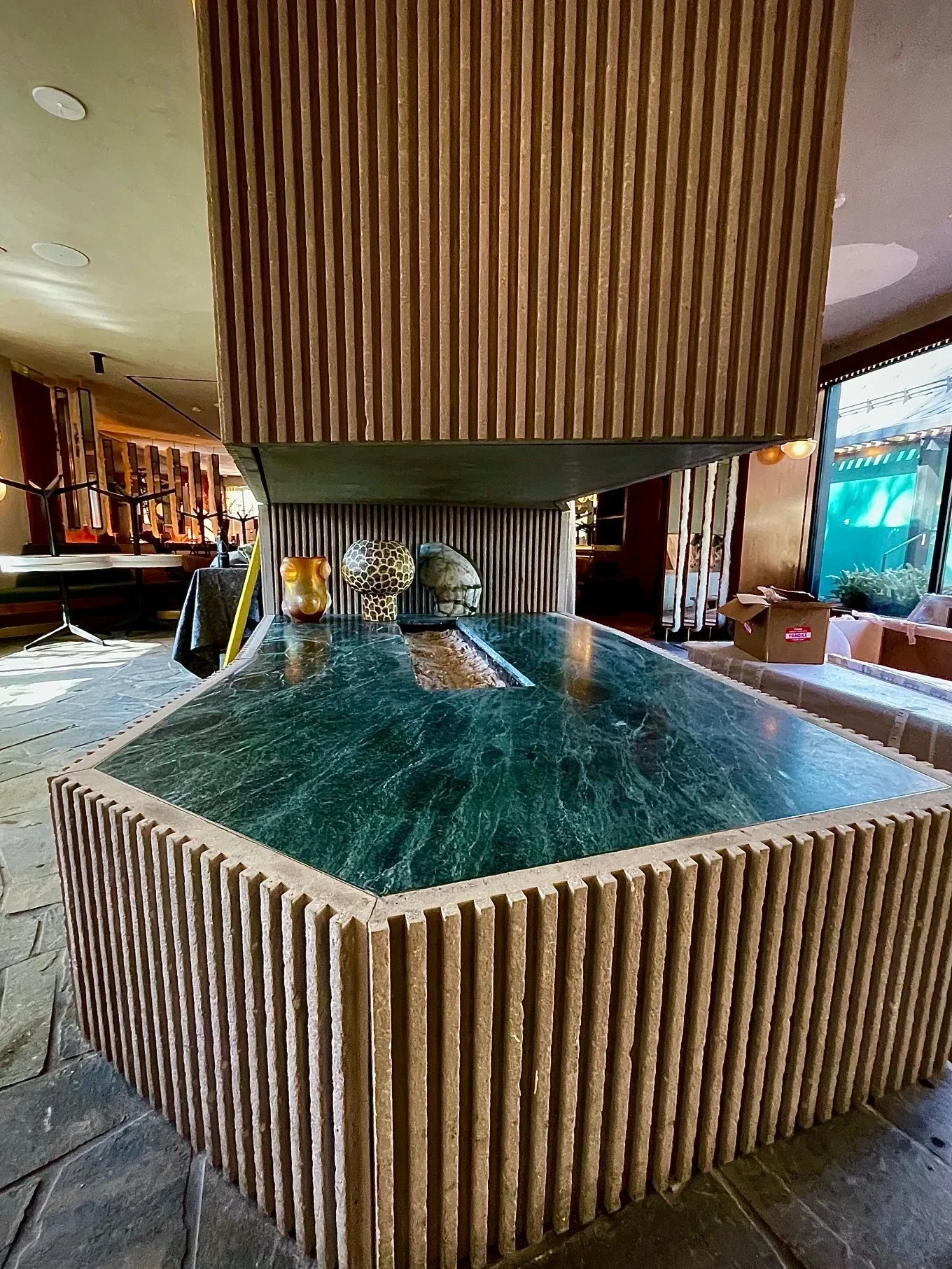
What is GFRC?
Glass Fiber Reinforced Concrete (GFRC) is at the core of our work — a material that allows us to push the boundaries of concrete design.
GFRC is significantly lighter than traditional concrete while maintaining exceptional strength and durability. This enables more refined forms, thinner profiles, and greater flexibility in application without compromising performance.
In addition to its structural advantages, GFRC offers a rich, tactile surface that enhances the visual and physical experience of each piece. It is well-suited for both indoor and outdoor use, withstanding weather, wear, and time.
-
GFRC is up to 70% lighter than traditional concrete, making it easier to handle, transport, and install — especially in larger formats.
-
Its composition allows for thinner walls and more intricate, sculptural forms that would be difficult to achieve with standard concrete.
-
Resistant to cracking, weather, and corrosion, GFRC performs well in both interior and exterior environments.
-
Offers a refined, consistent surface with natural variation, giving each piece a distinct yet elevated look.
-
Requires minimal upkeep and ages gracefully over time.
Our Process.
Our GFRC pieces are produced through a layered casting process that combines precision mold-making, reinforced concrete application, controlled curing, and hand-finishing. This allows us to create forms that are lighter, stronger, and more refined than traditional concrete.
Mold Creation
The process starts with a mold, usually made from polyester, rubber, steel or another form material depending on the shape and production volume. Since GFRC can capture fine detail, the mold quality matters a lot.
Thickness Control
The material is worked into the mold to remove air pockets and ensure even thickness. Depending on the piece, we may use rollers, vibration or hand pressure.
Finishing
This is where the final aesthetic really gets defined, whether smooth, raw, honed, stone-like, or heavily textured.
Mix Preparation
The GFRC mix is typically made from: cement, fine sand, water, polymer, admixtures/pigments, alkali-resistant glass fibers.
Reinforcement Detailing
In some cases, additional reinforcement is added such as: steel armatures or mounting hardware. This depends on the size and use of the piece.
Sealing & Protection
Most GFRC pieces are sealed to help with:stain resistance, water resistance, UV performance and easier maintenance.
Face-coat Application
A face coat is often applied first. This is usually a fiber-free or low-fiber slurry that creates the visible outer surface of the piece. It helps achieve a smoother finish, cleaner color consistency and more refined detail.This is the layer that really affects the final look.
Curing
After casting, the piece must cure properly so it can gain strength. Controlled curing is important for: durability, crack resistance, color consistency and reducing shrinkage issues.
Structural Layer
After the face coat begins to set, the structural GFRC mix is applied behind it. This is the reinforced layer containing the glass fibers that gives the piece its strength.
Demolding
Once the piece has gained enough strength, it is removed from the mold carefully to avoid edge damage or surface defects.